

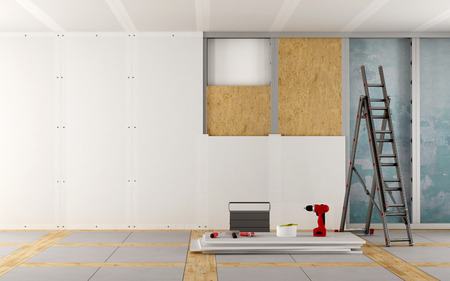
In this article, our aim is to explain a bit more about how to fit plasterboard on the ceiling, a subject so important in the construction sector.
Comfort, functionality and versatility are the adjectives that describe partition walls, since besides fulfilling their function of dividing spaces, nowadays they also offer thermal insulation, acoustic insulation and fire resistance. With all these features, plasterboard has become a great construction element with the highest technical standards.
Plasterboard partitioning is an ideal solution for compartmentalisation and layout; moreover, its technical characteristics speed up installation, which is much cleaner than usual since it is dry construction work. On the decorative side, it offers endless possibilities whatever your aesthetic needs may be.
Below we will describe in a bit more detail what plasterboard is, how it is fitted on the ceiling and the types of plasterboard available on the market.
✅➤ What is Plasterboard?
Plasterboard consists of gypsum panels laminated between two layers of cardboard. They are highly resistant to compression thanks to the gypsum and to bending thanks to the cardboard lining. There is a wide range of options in terms of thickness and size, depending on each customer or manufacturer to achieve the desired product.
For those thinking of renovating but who don't want to take on large-scale works, plasterboard may be a good alternative. These plaster-and-cardboard panels can be used in many ways, the most common being the creation of ceilings. But they can also be used to line walls, form interior partitions and build furniture.
Plasterboard is today a benchmark in interior building work. It owes this position above all to its multi-purpose, versatile nature. Its main advantages over other materials such as solid gypsum, plaster mouldings or brick are its easy installation, its ability to adapt to any surface and its cleanliness, since being a dry construction element it does not generate dust when worked with. However, before choosing this material it is worth getting to know its installation process, the different types of plasterboard available and other particularities.
✅➤ How to Fit Plasterboard on the Ceiling?
Plasterboard walls have an internal metal structure that acts as support and provides space for fitting acoustic and/or thermal insulation such as rock wool. The first step in fitting plasterboard on the ceiling is to take measurements of the wall and mark on the floor and ceiling where it will be located. Before carrying out the installation, we fit the acoustic strip to the channels, which will separate the floor from the metal profiles, and the same for the ceiling.
Once the acoustic strip has been fitted on the channels and the uprights are in contact with the walls, installation proceeds, starting with the floor. This installation has no great secrets; it involves drilling the profiles at the marks already indicated to fix them to the ceiling and the floor.
We then place the ceiling channel, not before fitting the acoustic strip that will be in contact with the wall. Once the channels are in place, the bottom and top ones, we proceed to fit the uprights.
Now we can install the various laminated gypsum plasterboard panels, taking measurements. First, we fit the panels on one side of the partition, and then proceed to install the thermal and/or acoustic insulation.
✅➤ How Many Types of Plasterboard Are There?
Although the original structure of plasterboard is made of cellulose and gypsum, the inner core can be made of different materials depending on the intended application. This gives us:
1️⃣ Plasterboard N
This is the standard panel, made up of a naturally white gypsum core with the visible side in light grey or white. It is used for all general applications of the material such as decoration, building work, etc.
2️⃣ Plasterboard TEC
Although initially it has similar characteristics to the above, its components have been duly reinforced, specially suited to fitting continuous ceilings.
3️⃣ Plasterboard WA
These are panels that incorporate silicone oils, both in their surface cellulose and in their gypsum core (waterproofing treatment), making them water-resistant. This advantage makes it perfect for bathrooms or places exposed to the elements, such as porches. To distinguish it on site, the artificial cellulose is green.
4️⃣ Plasterboard FOC
Fire-resistant, its special characteristic comes from the glass fibre incorporated into the gypsum core. To distinguish it on site, the cellulose is pink.
5️⃣ Plasterboard GD
Although the standard variety is fairly impact-resistant, this particular type has reinforced hardness, so its installation is considered for areas prone to impact (commercial or leisure premises, hospitals, schools, etc.).
6️⃣ Plasterboard FON
This is a new range of laminated gypsum panels with perforations of different geometries and a glass fibre veil on the back to improve acoustic absorption. Although intended for public spaces such as cinemas, hotels, cafés, restaurants, function halls, etc., it is also very suitable for common areas in homes (hallways, entrance halls, entryways, etc.).
✅➤ How to Cut Plasterboard?
Cutting a plaster-and-cardboard panel is very simple; you only need a cutter knife and a guide or ruler to help make the cut in a straight line. To get a perfect cut with almost no effort, once the first layer is cut you simply need to fold the panel and pass the cutter over it again.
If the edge is left rough, you can pass a brush over it a couple of times to smooth it.
✅➤ How Much Does It Cost to Fit Plasterboard on the Ceiling?
The answer to this question has two parts: the price of materials and of labour. Calculating your budget correctly is essential, because it can save a lot of money, time and stress. You can get an accurate estimate once you have decided on another important matter, which is measuring the surfaces.
Then you will need to select the materials. Payresa can help you make this choice.
There are many types of false ceilings. Most false ceilings used in homes, formerly made of plaster mouldings, are now plasterboard, because they are cleaner and easier to install. For a home, whether new or renovated, it is most advisable to install plasterboard false ceilings, since you can paint over them and fit light fixtures cleanly and easily.
The final price of installing a false ceiling will depend on the square metres to be installed. Prices can range between €150/square metre and €250/square metre, including paint and openings for lighting, depending on the surface to be covered.
✅➤ Where to Buy Cheap Plasterboard in Málaga?
If you are looking for a quote to buy plasterboard at a good price, get in touch now and we will be at your disposal to give you a personalised price for the work you want to start.
We have professional plasterboard installers who can draw up quotes for building plasterboard partitions with no obligation and with the peace of mind of years of experience installing all types of plasterboard ceilings.
After the experience gained in all types of plasterboard installations in offices and homes, we can carry out a fast installation process.
If you are interested in knowing the price of plasterboard per m2 or want to know more about the installation of parquet in Málaga, our professionals can advise you so that your renovation is affordable without sacrificing the quality of the finishes. With plasterboard, great results are achieved without a big investment.
Contact us with no obligation for a personalised quote tailored to your needs, or to resolve any other query you may have.