

Table of contents
Why install floating floorboardsHOW TO INSTALL FLOORBOARDS IN HALLWAYSWhat direction should floorboards be laid in: step by stepPrepare the surfaceChoose the direction and layoutFit the planksWhat direction should floorboards be laid in? Find out how to correctly install floating floorboards on the floors of your home.
One of the most valued options in recent years for covering the floors of homes or premises is floating floorboards. Thanks to their characteristics and versatility, they adapt to any style, making them perfect for any room.
However, there are many doubts about how to install it. One of the most frequent is what direction floorboards should be laid in. In this post, from Payresa, parquet and floorboard specialists, we tell you everything you need to know when installing this type of flooring in the rooms of your home. Don't miss it!
Why install floating floorboards
If you're thinking about renovating the floors of your home or business, you may be considering floating floorboards as one of the options. This type of flooring is made of natural wood, just like parquet. It's often confused with laminate, but laminate imitates the natural look of wood while being made of synthetic materials.
Although parquet and floorboards share the nature of their materials, they differ fundamentally in the way they are installed. While parquet consists of boards glued to the floor, floorboards have a much simpler installation since they're laid over the existing floor.
The fact that it's made from natural wood, that its maintenance is simple, that it's very durable and resistant, and that its installation doesn't require renovation work, makes floorboards a perfect option for any type of space.
HOW TO INSTALL FLOORBOARDS IN HALLWAYS
This is one of the most frequent questions when renovating floors in long, narrow spaces. To achieve a professional finish, it's first essential to level and clean the surface, making sure it's dry and free of imperfections. Then, it's recommended to install an insulating underlay that improves stability and reduces noise. When deciding on the direction, it's best to lay the planks in the direction of the light or along the length of the hallway to create greater visual spaciousness. Finally, leave a small expansion joint at the edges and fix the skirting boards for a durable, aesthetic result.
What direction should floorboards be laid in: step by step
Installing floating floorboards is something you can do yourself without any prior knowledge. Just by following the steps we leave you below, you'll be able to install it easily:
Prepare the surface
Before laying the floorboards, it's important to clean the surface of the floor where we're going to install it. To do this, no complicated process is needed, sweeping or vacuuming it properly to remove dust and mopping it will be enough.
In case we want to achieve thermal and acoustic insulation, at this step we should line the floor with polyethylene foam. Simply cut the foam into strips or sheets and lay them perpendicular to the direction in which the floorboards will be laid.
Lastly, it's advisable to leave the floorboards to be installed in the room a few days beforehand. This way, we'll get them to adapt to the humidity of the environment and avoid them expanding once installed.
Choose the direction and layout
Although there's no rule dictating what direction floorboards should be laid in, there are a number of factors to take into account when making the decision. First of all, we should keep in mind that the direction we choose will be maintained throughout all the rooms of the house. That's why it's advisable to choose the direction of the boards based on the largest or most used room in the house (usually the living room) or the hallway's direction. In this latter case, if we have a hallway of considerable size, it's most common to lay the planks lengthwise, parallel to the walls.
If we're going to take a room into account, we can consider its shape and the direction of the natural light it receives. In this sense, we can lay the floorboards parallel to the longest walls or parallel to the direction of the light coming in through the windows.
Fit the planks
To fit the floorboard planks, the first thing we must do is carefully measure the dimensions of the room so we can cut the boards to size. In addition, we must take into account the space we need to leave as margin for the expansion joint (it should be about 15 millimeters). Using wedges between the wall and the floor will ensure we leave the necessary space.
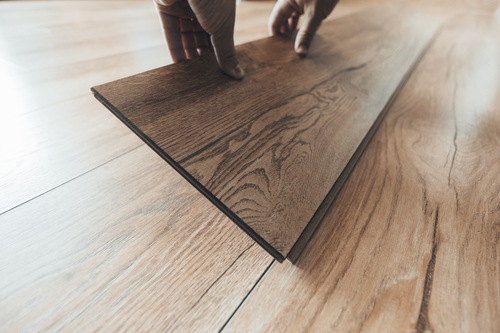
After that, we just need to join the planks together using their tongue-and-groove system. With the help of a hammer and a wooden block, it will be easier to fit each piece together.
Finally, we must install the skirting boards. To do this, after removing the wedges, we'll fit them using mounting adhesive.
As you can see, when deciding what direction floorboards should be laid in, a number of factors and aesthetic preferences must be taken into account, but there's no universal rule. At Payresa we advise that, if you're not sure, you ask for professional advice to achieve the best results. Our parquet and floorboard specialists are at your disposal. Don't hesitate to contact us!